NBEO Part 1 Optics Guide: Vergence, Magnification, and Binocular Vision
Master NBEO Part 1 optics with a focus on vergence, spectacle magnification, low vision, binocular vision, and contact lens calculations. Learn why conceptual understanding now beats formula memorization.
NBEO Part 1 Optics Guide: Vergence, Magnification, and Binocular Vision
Optics is the largest domain on NBEO Part 1, at 31-35% of scored items. Recent student reports describe exam optics as increasingly conceptual and image-based, with less reliance on straightforward formula plugging. To pass, you need deep understanding of vergence, spectacle magnification, ophthalmic optics, low vision, binocular vision, and contact lens calculations. Memorizing formulas alone is no longer enough — and we'll explain why that shift matters for your study plan.
If there is one area where extra time pays off on NBEO Part 1, it is optics. The discipline accounts for roughly 108 to 122 scored items. Students who report passing comfortably almost always credit strong optics performance. Students who fail often point to optics as the section that broke them. This guide covers the topics you must master and the conceptual shift that the current exam rewards.
The Conceptual Shift
For years, optics prep emphasized formula sheets. Recent forms have moved away from plug-and-chug items toward conceptual and image-based questions. Students report seeing equations that did not seem to work directly on the real item and being forced to reason through the underlying optics rather than calculate mechanically. This means your preparation must teach understanding, not just memorization.
The best way to build conceptual fluency is to draw ray diagrams, explain concepts in your own words, and solve problems from multiple angles. If you can teach why a lens does what it does, you are more likely to handle an unfamiliar item on test day.
Vergence and Accommodation
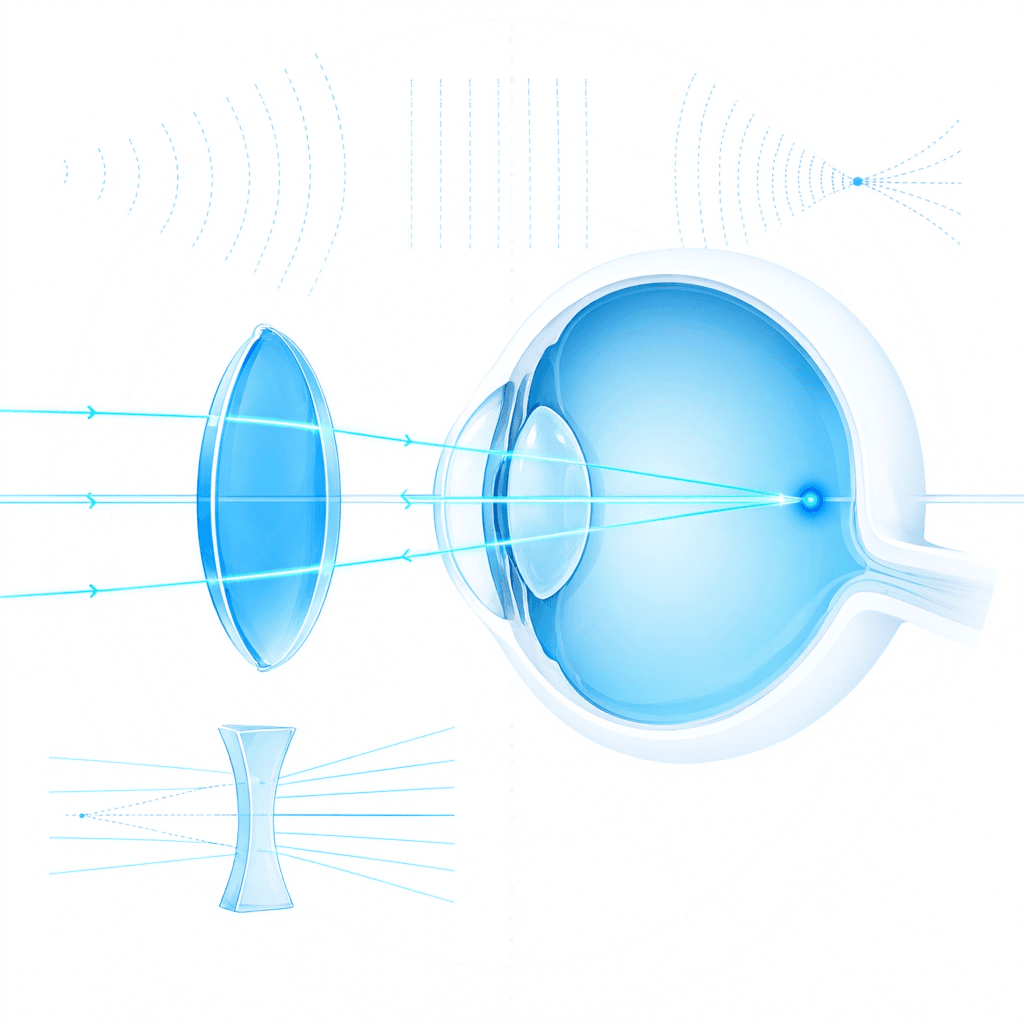
Vergence is the foundation of geometrical optics. You must be comfortable with:
- Converging and diverging light.
- Object and image vergence relationships.
- The vergence equation and equivalent power concepts.
- Near-point and accommodation amplitude.
- Accommodative demand and near-work calculations.
Practice moving back and forth between the object space, the lens space, and the image space. Many optics errors come from using the wrong sign convention or misidentifying which surface is which. We've graded enough practice questions to know that sign errors are the #1 way students lose easy optics points — write your convention at the top of the page and stick to it.
Spectacle Magnification and Relative Spectacle Magnification
Spectacle magnification is a perennial high-yield topic. You should understand:
- The two components: power factor and shape factor.
- How spectacle magnification changes with vertex distance and lens power.
- Relative spectacle magnification and aniseikonia.
- Why high-power lens changes affect image size and patient adaptation.
These topics reward conceptual understanding. A student who only knows the formulas may struggle when the item presents an unusual lens form or asks about the effect of moving the lens closer to the eye.
Ophthalmic Optics
Ophthalmic optics covers the lenses we actually prescribe and dispense. High-yield topics include:
- Lens power in oblique meridians and cylindric lenses.
- Prism and prism decentration.
- Prentice rule and induced prism.
- Base curve, lens thickness, and lens design.
- Aspheric and atoric lens considerations.
- Lens materials and index of refraction.
Work through problems that combine sphere, cylinder, and prism. A common exam pattern is to ask what happens when a lens is decentered or when a prescription changes in one eye.
Low Vision Aids
Low vision is a smaller but reliably tested area. You should know:
- Magnification systems: relative distance, relative size, and angular magnification.
- Telescopic systems and reading caps.
- Field expanders and image minification.
- The trade-off between magnification and field of view.
- Prescribing considerations for patients with central versus peripheral vision loss.
Low vision items often appear in the context of a patient scenario, so practice translating a clinical goal into the right optical aid.
Binocular Vision
Binocular vision connects optics to clinical optometry. High-yield topics include:
- Extraocular muscle actions and the innervation of each muscle.
- Cranial nerve palsies and their effects on eye position and motility.
- Fusional reserves and vergence ranges.
- Retinal correspondence and anomalous correspondence.
- Amblyopia prescribing and treatment timing.
- Accommodation and vergence interactions (AC/A ratio, convergence accommodation).
A strong binocular vision foundation also helps with the neuro-ophthalmic anatomy items that appear elsewhere on the exam.
Contact Lens Calculations
Contact lens optics requires you to translate spectacle prescriptions into lens parameters. High-yield topics include:
- Vertex distance compensation for high-power lenses.
- Effective power and reduced thickness concepts.
- Over-refraction and lens power adjustment.
- Tear lens effects with rigid lenses.
- Base curve selection and corneal topography considerations.
These items often combine multiple optical concepts in one scenario. Practice with realistic prescriptions and patient data rather than simplified textbook examples.
Study Strategy for Optics
Optics rewards deliberate practice. Here is a proven approach:
- Watch or read a concept explanation first.
- Solve several problems by hand, without looking at the formula sheet.
- Draw a ray diagram for every calculation.
- Explain the answer out loud or in writing.
- Add missed concepts to flashcards with an image or diagram.
- Revisit optics every week, not just once.
Allocate at least one full day per week to optics during the heavy study phase. In the final month, include optics blocks in every mixed review session so the concepts stay fresh.
Practice and Calibration
Full-length mock exams are the best way to calibrate your optics readiness under timed conditions. Many students report that optics clusters appear early in both sessions, so time management is critical. If you fall behind on the first optics block, it can cascade through the rest of the session. Practice flagging and moving on when a calculation is not coming together quickly.
If you want extra optics-focused practice with detailed explanations, our platform includes video crash courses, thousands of questions, and AI tools to generate targeted drills on demand. See plans and pricing when you're ready.
Common Optics Calculation Errors and How to Avoid Them
Even students who understand optics conceptually can lose points on simple calculation errors. These are the most common traps and how to avoid them.
Sign convention errors. Vergence calculations depend on consistent sign conventions. Object vergence, image vergence, and lens power all have sign rules that must be applied correctly. Write the sign convention at the top of your scratch paper before you start a calculation and check every value.
Vertex distance confusion. When converting a spectacle prescription to a contact lens prescription, the vertex distance changes the effective power. Students often forget to convert when the power is high or when the problem switches between spectacle and contact lens plane. Identify the plane of the given power before you calculate.
Prism decentration direction. Prentice rule gives the magnitude of induced prism, but the direction matters too. Draw the lens and the decentration before deciding base direction. A quick sketch prevents direction errors.
Magnification versus effective power. Spectacle magnification and relative spectacle magnification are not the same as effective power. Make sure you are answering the question being asked. If the stem asks about image size, do not default to a power calculation.
Contact lens over-refraction missteps. When a patient wears a contact lens and you refract over it, the final lens power depends on the trial lens power and the over-refraction. Combine the two carefully and consider whether the result is in the contact lens plane or the spectacle plane.
Quick Review Checklist for NBEO Part 1 Optics
Use this checklist to make sure your optics preparation is deep enough for the current exam.
- You can explain vergence, accommodation, and lens power without relying on formula sheets.
- You understand spectacle magnification and relative spectacle magnification.
- You can solve ophthalmic optics problems involving prism and lens decentration.
- You have reviewed low vision aids and their trade-offs.
- You know extraocular muscle actions, cranial nerve palsies, and binocular vision concepts.
- You can perform contact lens calculations including vertex distance and over-refraction.
- You have drawn ray diagrams for the major optical systems.
- You practice optics every week, not just once during the review cycle.
Optics mastery is the single biggest leverage point on NBEO Part 1.
What This Means for You
Optics is the domain where focused effort produces the biggest score return. If you are currently weak in optics, you should allocate more time to it than to any other subject until you reach a solid level. This means solving problems by hand, drawing ray diagrams, and explaining concepts out loud. It also means practicing under timed conditions so that optics clusters do not slow you down on test day. A strong optics performance can compensate for weaknesses elsewhere, but a weak optics performance is very hard to overcome. Make optics your priority and your confidence will grow across the entire exam.
Key Terms to Remember
- Vergence: The measure of light convergence or divergence, foundational to geometrical optics and lens calculations.
- Spectacle magnification: The change in image size produced by a spectacle lens, influenced by power factor and shape factor.
- Relative spectacle magnification: The comparison of image size with a spectacle correction to the image size in a standard emmetropic eye, relevant to aniseikonia.
- Prentice rule: The formula for calculating induced prism from lens decentration: prism = power times decentration in centimeters.
- Contact lens over-refraction: The refraction performed while a patient wears a trial contact lens, used to determine the final lens power.
- Binocular vision: The coordinated use of both eyes, including fusion, accommodation, vergence, and the actions of extraocular muscles.
Optics is the highest-weight domain on NBEO Part 1; master vergence, spectacle magnification, ophthalmic optics, low vision, binocular vision, and contact lens calculations. Start early, practice every week, and don't let a single calculation error derail your score. If you want a platform that takes optics seriously — with deep video explanations and targeted practice — check out plans and pricing when you're ready.
Ready to crack the NBEO Part 1?
Crack the Optometry Boards gives you 5 full-length NBEO Part 1 mock exams, 5,000+ exam-style questions, 30+ hours of video crash courses, 20,000+ flashcards, and a complete study engine: Adaptive Quiz Generator, Adaptive Flashcard Generator, AI Tutor, Homework Helper, YouTube Summarizer, and Study Schedule Creator. Everything is aligned to the official NBEO Part 1 blueprint and comes with unlimited tokens, unlimited credits, no throttling, unlimited access, and unlimited usage. No subscriptions, no usage caps.
No credit card required for the free trial. One-time payment for full access.
Related articles
NBEO Part 1 High-Yield Topics by Content Blueprint
Focus your NBEO Part 1 prep on the topics that appear most: optics, systemic health, neuro-ophthalmic anatomy, pharmacology, and the item-style traps that cost points.
Section GuidesNBEO Part 1 Anatomy and Physiology: Ocular and Neuro Topics
A focused guide to NBEO Part 1 anatomy and physiology: ocular anatomy, neuro-ophthalmic pathways, cranial nerve palsies, pupil defects, and visual pathway lesions.
Section GuidesNBEO Part 1 Pharmacology and Systemic Health Review
Master NBEO Part 1 pharmacology and systemic health: drug classes, mechanisms, ocular side effects, and the systemic disease topics that make up the largest condition area on the blueprint.
Turn strategy into a passing NBEO Part 1 score
5 full-length NBEO Part 1 mock exams, 5,000+ questions, 30+ hours of video, and unlimited AI tools. Start today.
Unlock Everything